Freemasonry and the Construction of the Panama Canal
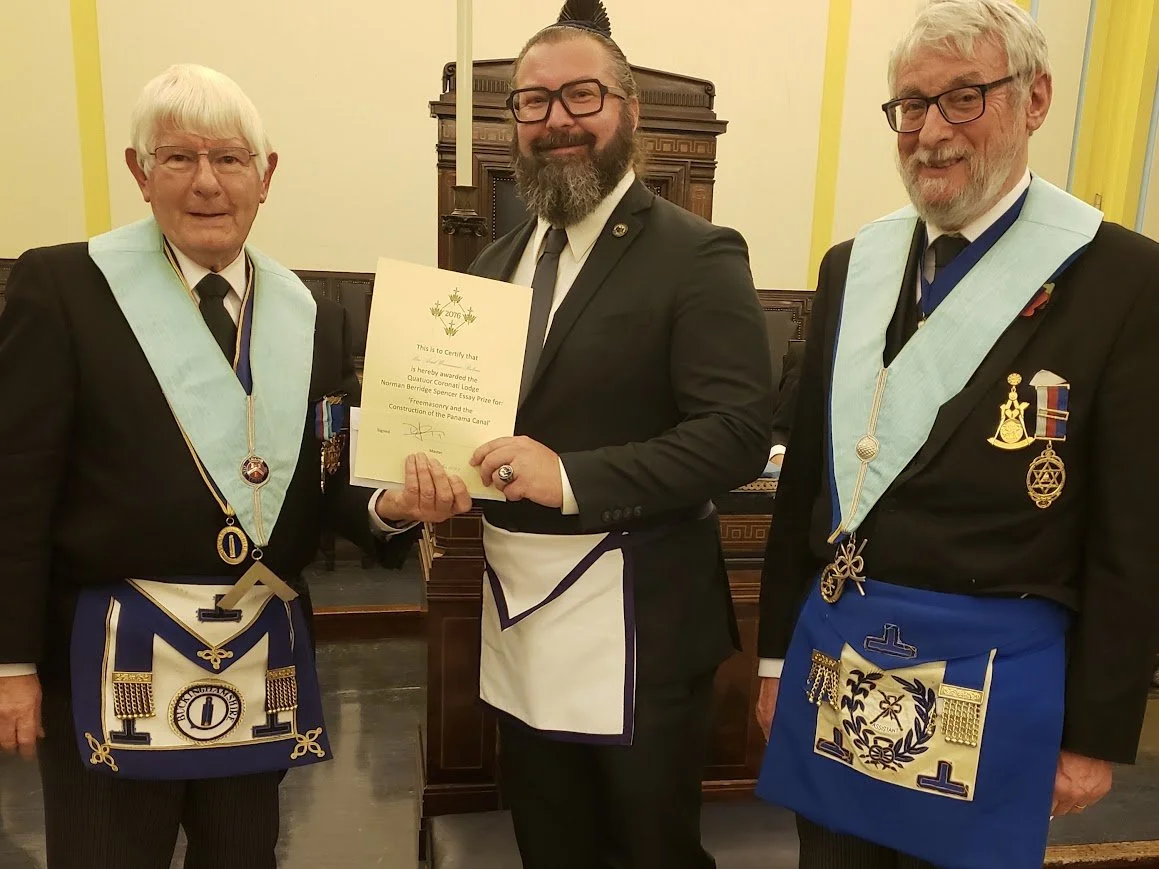
Bro. Weinmann-Rubino receiving the Norman B. Spencer Prize from Wor. David Peck, Master of Quatuor Coronati Lodge No. 2076 in Freemasons’ Hall, London on November 9th, 2023.
Bro. Ariel Weinmann-Rubino
Winner of the 2023 Norman B. Spencer Prize
INTRODUCTION
The creation of the Panama Canal stands as a testament to human ingenuity and engineering prowess, revolutionizing global trade and maritime navigation. Amidst the intricate web of decisions, negotiations, and monumental challenges that shaped this colossal project, an often overlooked but significant factor emerges: the influential role of Masonic leadership. The presence of Freemasons in both the United States government and the nascent Panamanian government played a vital role in the selection of Panama as the canal's location and Panama’s successful separation from Colombia. Moreover, their contribution extended beyond the strategic decision-making process, as Masonic leadership fostered a cohesive social structure for the men working on the canal during its construction and after. This paper will explore how Masonic leadership, both in the interested governments and amongst the canal workers, was essential to the independence of the Republic of Panama and the creation of a supportive environment vital to the canal's completion.
POLITICAL BACKGROUND
Panama was part of the Spanish Empire for over three centuries from 1513 to 1821. In 1808, the forced abdications of successive Spanish kings in favor of the French Emperor Napoleon I and his brother Joseph resulted in the Peninsular War fought between Spain, Portugal, the United Kingdom, and France. This conflict was the catalyst for the Spanish American Wars of Independence that began that same year. Between 1820 and 1823, a liberal government known as the Trienio Liberal took control of Spain. Despite this government’s attempt to avert Panamanian independence with the promise of a constitutional monarchy, Panama bloodlessly declared independence from Spain on 28 November 1821 and immediately united with Gran Colombia (roughly modern Colombia, Ecuador, Panama, and Venezuela).
Panama separated from Gran Colombia in 1830 along with Venezuela and Ecuador. In 1831 Panama rejoined what was left of the republic, forming the Republic of New Granada, which roughly corresponds to modern Panama and Colombia. In 1840, General Tomás de Herrera declared Panama’s independence as the Free State of the Isthmus. Panama reunified with 2 New Grenada in 1841, sequentially forming the Granadine Confederation, United States of Colombia, and later the Republic of Colombia.
In 1846, the United States of America and Colombia signed the Bidlack-Mallarino Treaty, granting the United States transit rights across the isthmus and the power to enforce these transit rights with military force. This resulted in the world's first transcontinental railroad, the Panama Railway, being completed in 1855 and the United States’s first of many military interventions on the isthmus in 1856.
During this period, Colombia experienced an ideological tug-of-war between centralist and federalist parties. This conflict and its resulting constitutions granted Panama varying levels of administrative autonomy, forming the Federal State of Panama from 1855 to 1863 and the Sovereign State of Panama from 1863 to 1886. This resulted in Panama being politically unstable and oscillating between effective self-governance and subjugation by a government seated in an Andean plateau a three to four weeks' voyage away.
By 1874, stock in the Panama Canal Railway was selling at $369 per share on the New York Stock Exchange and the value of Panama suddenly caught the world’s attention. In 1881, the first attempt to construct a canal through Panama was inspired by Ferdinand Marie, Comte de Lesseps, a French diplomat who as vice-consul to Alexandria and later consul general to Cairo was able to use his relationships with Egyptian officials to construct the Suez Canal between the Mediterranean and Red seas. This was done between 1859 to 1869 through a French company, la Compagnie Universelle du Canal Maritime de Suez, with French investors initially holding half of the company’s stock. The success of the Suez Canal saw de Lesseps use his power and celebrity to similarly form la Compagnie Universelle du Canal Interocéanique de Panama with the goal of creating a canal through the Isthmus of Panama to connect the Atlantic and Pacific oceans.
In 1878, the French officer and engineer Lucien Napoléon Bonaparte Wyse signed a treaty with the Colombian government to build a canal through Panama. This Wyse Concession was sold to the French company and construction began on 1 January 1881. While de Lesseps was able to raise considerable funds based on the profits generated by the Suez Canal, the French endeavor underestimated the difficulty of the enterprise and in 1889 the French company went bankrupt after spending $287,000,000 and losing the investments of 800,000 investors. More 3 significantly, in eight years of construction, an estimated 22,000 men died from either disease or accidents. Work on the canal was suspended on 15 May 1889 and a number of the company’s leaders were prosecuted by the French courts. In 1894, a second French company, la Compagnie Nouvelle du Canal de Panama, was created to take over the project with Phillipe Bunau-Varilla as its manager.
MASONIC BACKGROUND
As part of the Spanish empire, Freemasonry had been banned in Panama since 28 April 1738 when Pope Clement issued In eminenti apostolatus, condemning Freemasonry and forbidding Catholics from joining the fraternity. As a result, being a Freemason was made a capital offense under the jurisdiction of the Inquisitor General of the Spanish Inquisition.
Freemasonry reappeared in Spain in 1808 along with the invading French soldiers. After the French retreated from the peninsula in 1813 and King Ferdinand VII was restored to the Spanish throne that next year, the persecution of Freemasons by the Inquisition returned and ultimately reached its peak. This persecution remained the status quo until the Trienio Liberal briefly brought Freemasonry into Spanish life and politics from 1820 to 1823. In 1824, Ferdinand reinstated the prohibition against Freemasonry.
The fraternity was introduced to Panama through two routes, both at roughly the same time. The first route was through Panamanian merchants traveling to the British colony of Jamaica. That the island was a significant source of liberal ideas is evinced by the fact that in March 1820, the isthmus’s first printing press was imported to Panama from Jamaica by José María Goytia (also written Golltia and Goitia), eventual Master Mason and revolutionary Lieutenant Colonel. The press almost immediately began printing Panama’s first newspaper (La Miscelánea) that was instrumental in shifting public opinion toward republican principles and ultimately printed Panama’s Act of Independence on 28 November 1821. The second route for Freemasonry to enter Panama was from revolutionary Masons who brought continental European Freemasonry to Latin America, especially that of the French variety.
Panama’s first lodge, La Mejor Unión, was organized in Panama City on 14 July 1821 under the jurisdiction of the Grand Consistory of Paris (Supreme Council of France of the Ancient and Accepted Scottish Rite) as proven by the English translation of a letter drafted on 8 4 October 1822 by the members of La Mejor Unión requesting permission to operate under the jurisdiction of the Grand Lodge of the State of New York that is currently in the possession of the Robert R. Livingston Library in New York. On 27 December 1823, La Mejor Unión was granted a second Warrant of Constitution under number 365 of the Grand Lodge of New York. On 8 October 1824 the lodge received a third Warrant of Constitution under the National Grand Orient of Gran Colombia (Gran Oriente Nacional Colombiano). Panama’s first and only lodge was closed after Simón Bolívar prohibited Freemasonry in Gran Colombia on 8 November 1828.
Freemasonry was reintroduced to the isthmus a number of times during the last half of the nineteenth century, usually to suit the needs of temporary American and European workers and travelers. For example, the California Gold Rush and the construction of the Panama Railroad resulted in Union Lodge No. 82 being chartered by the Grand Lodge of Texas in 1852. The demand for this lodge was apparently low, as it closed a year later in 1853. In 1866, the Grand Lodge of Massachusetts granted a Charter of Dispensation to the anglophone Isthmus Lodge, however, this charter was withdrawn and Isthmus Lodge was ultimately granted a charter by the Grand Orient of Colombia as it was deemed that this new lodge fell under its jurisdiction.
Between 1887 and 1895, the lodges Luz de Oriente, Fidelidad, Le Travail, La Estrella del Pacífico, Granada, Unión Fraternal, and Manzanillo were established in Panama City and Colón under the authority of the Grand Orient of Colombia. In 1898, the Grand Lodge of Scotland granted a charter to Sojourners Lodge No.874 in the city of Colón, which was made up mostly of English-speaking members.
FREEMASONRY AND THE PANAMA CANAL
The separation of Panama from Colombia and the subsequent construction of the Panama Canal stands as a pivotal moment in history, reshaping geopolitics and global trade routes. Behind these significant events lay a web of intricate negotiations, strategic alliances, and diplomatic maneuvers. However, amidst this landscape, an often-overlooked factor emerges as a key catalyst for success: the influential role of Freemasons. The fraternity played a crucial part in leading the separatist movement and securing vital support from within the United States government. Through their cohesive efforts, the Freemasons navigated the complex waters of 5 diplomacy, forging a path towards Panama's independence and the eventual construction of one of the world's engineering marvels, the Panama Canal.
The United States had been interested in building a canal through Central America for much of its existence, with support coming from all quarters of American society for a myriad of and sometimes conflicting reasons. Generally speaking, Easterners saw the canal as a way to take advantage of the riches of the American West while Westerners saw the canal as a way to take advantage of the riches of the American East. Southerners saw a canal (especially a Nicaraguan canal) as a way to reinvigorate Southern ports (especially those in the Gulf of Mexico) in the aftermath of the American Civil War (1861 to 1864).
On 28 January 1902, United States Senator John Coit Spooner introduced an amendment to a bill that was already before the chamber. This amendment authorized the President of the United States of America to acquire the French Panama Canal company’s Panamanian property and concessions for no more than $40,000,000; to acquire control of a canal zone at least six miles wide across the isthmus from Colombia; and to build a Panama canal. In June of that same year, the United States Senate voted in favor of the bill.
I. FREEMASONRY AND THE PANAMANIAN SEPARATIST MOVEMENT
In accordance with the Spooner Act, the Hay-Herrán Treaty was signed by United States Secretary of State John Hay and Colombian chargé d'affaires Tomás Herrán on 22 January 1903. Neither men were Masons, though Tomás Herrán’s father, Pedro Alcántara Herrán, general and former President of Colombia, had been before his death in 1872. In accordance with the treaty, the United States would pay Colombia $10,000,000 and an annual payment of $250,000 - all in gold coin - in exchange for a 100 year lease on a six mile wide strip of land across the isthmus. This treaty was ratified by the United States Senate, but the Colombian Senate refused to do so and so never went into effect.
At the same time, José Agustín Arango Remón, a Mason and Isthmian politician, began to work secretly for separation from Colombia. Nicknamed “The Master” by his peers, a clandestine revolutionary junta formed around him to plan a revolution aimed at separating the isthmus from Colombian sovereignty and negotiating directly with the United States for the construction of the canal. This separatist movement found support and leadership within the 6 ranks of Panama’s Freemasons and the fraternity, with its principles of brotherhood, enlightenment, and civic duty, provided a framework for cohesive action. Separatist membership in the fraternity not only facilitated unity among the movement's leaders but also enabled strategic coordination and decision-making.
Apart from Arango himself, the conspiracy was made up of Manuel Amador Guerrero, Carlos Antonio Mendoza Soto, Federico Boyd, Tomás Arias, and Manuel Espinosa Batista, among others. Of this group, four were Masons, with only Amador Guerrero and Boyd being profanes. Significantly, Arango, Boyd, Arias, and Espinosa Batista would go on to form the Republic of Panama’s first government in 1903, with the Junta Provisional de Gobierno de Panamá (Panamanian Provisional Government Council) therefore being comprised of three Masons and one profane.
The first known organized meeting of the separatist movement was held at a country estate outside Panama City in July 1903. Tellingly, Dr. Amador was not present, but the United States consul general at Panama City, Hezekiah Gudger, was.
II. MASONIC SUPPORT FROM THE UNITED STATES GOVERNMENT
In 1897, United States President William McKinley had appointed Hezekiah Alexander Gudger as United States consul general in Panama. Before his appointment to Panama, Gudger served two terms from 1891 to 1892 as Grand Master of the Grand Lodge of Masons in North Carolina.
The efforts of Freemasons within the United States government played a pivotal role in supporting Panama's cause for separation and facilitating the subsequent construction of the Panama Canal. The fraternity’s emphasis on brotherhood and mutual aid extended beyond national borders. American Freemasons in positions of power and influence facilitated diplomatic efforts to support Panama's independence, with shared Masonic ideals enabling a level of trust and cooperation that greatly facilitated negotiations. This had been lacking in the negotiations between France and Colombia and the United States and Colombia, with profit taking precedence over every other motivation.
President Theodore Roosevelt, a Freemason himself, played a central role in championing the construction of the Panama Canal and Panamanian independence once he 7 became aware of its possibility. The project held immense strategic and economic value for the United States, and while Roosevelt felt strongly that a Mason should never use his membership in the brotherhood for political gain, his support for Panama's independence further solidified the partnership between the Freemasons in both nations. In his November 1902 address to the Grand Lodge of the State of Pennsylvania on the 150-year anniversary of the initiation of George Washington as a Freemason he said, “Each one of us that is worth his salt is trying to do his share in working out the problems that are before all of us now at the beginning of the twentieth century. Any man in public life, whatever his position be, if he is interested at heart, has the desire to do some kind of substantial service to his country. He must realize that the indispensable prerequisite of success under our institutions is genuineness in the spirit of brotherhood.” This sort of messaging emboldened Masons within the United States government to build the “American Canal” and to use their positions within the United States government to do so.
III. THE SEPARATION OF PANAMA FROM COLOMBIA
The separatists planned to start the revolution on an undefined day in November 1903. Rumors of unrest or a possible Nicaraguan invasion of the isthmus reached Bogota and the Colombian government ordered General Juan Tovar to the city of Colón with a battalion. His orders were to relieve and arrest General Esteban Huertas, whose loyalties were under question by the authorities in Bogota. The soldiers arrived in Colón and the general disembarked on the morning of 3 November 1903. While the general had no problem disembarking from his ship, he soon discovered that his transport to Panama City aboard the railroad was unexpectedly delayed and would continually suffer a series of setbacks, as the railroad authorities were themselves separatists and American conspirators. Ultimately, this led to only the general and his staff being transported to Panama City while his battalion remained on the ships.
Upon his arrival in Panama City, General Tovar and his staff were arrested on the orders of General Esteban Huertas, the man that they had themselves come all this way to arrest, who they discovered was the commander of the separatist Panamanian army.
Days earlier, Commander John Hubbard of the USS Nashville had been ordered by his superiors in Washington, D.C. to sail to Colón from Jamaica and further ordered to wait. 8 Commander Hubbard was unsure about exactly what he was waiting for, but upon learning about the arrest of General Tovar, he and the Nashville prevented the landing of more Colombian troops, arguing that the neutrality of the railway should be respected in accordance with the Bidlack-Mallarino Treaty.
With a Colombian general under arrest and the Colombian battalion unable to make landfall, the separatists moved to declare Panama’s independence. While some Panamanians stormed armories and seized weapons, this was ultimately unnecessary. The separatists took Governor José Domingo de Obaldía, himself a separatist, into custody as the representative of Colombian authority and the Colombian squadron anchored in the Bay of Panama surrendered without a fight.
As the de facto authority, the Panama City Municipal Council met and declared that from 4 November 1903 the Panamanian Provisional Government Council would be in charge of the administration of the new State.
On 13 November 1903, the United States of America formally recognized the Republic of Panama. France would recognize Panama the following day. On 18 November, the United States signed a treaty for the construction of the Panama Canal. Bogota was unaware of the separation of Panama until 6 December.
IV. THE CONSTRUCTION OF THE PANAMA CANAL
Masons and Masonry on the Panama Canal, published in 1914 by the Masonic Club of Empire, Canal Zone, Republic of Panama, includes in its introduction, “As Masons we do not claim, by any means, all of the credit for the construction of the Panama Canal. Nor do we wish to give the impression that we believe that, were it not for the Masons, the Panama Canal would not have been successfully built. We simply feel a pardonable pride in the fact that we have been individually, and collectively as a fraternity, prominent among the builders of the Panama Canal.”
This is no understatement, as the number of Masons who worked on the Panama Canal is truly staggering: in 1904 the United States government formed the Isthmian Canal Commission, headed by Mason and United States Secretary of War William Howard Taft. The commission appointed John Findley Wallace, a skilled engineer and Freemason, as Chief Engineer of the 9 Panama Canal project. The first scoop of dirt removed by a steam shovel on the American canal was by a Mason, William H. Bates, member of Seymour Lodge, No. 277, of Port Dalhousie, Ontario, Canada and the last scoop of dirt was dug on 11 September 1913 by Albert H. Geddes, member of Sojourners' Lodge, A. F. & A. M., a Thirty-second Degree Mason of the Grand Consistory of Louisiana, and a member of Osman Temple, Ancient Arabic Order, Nobles of the Mystic Shrine. In this act he was assisted by craneman William I. Hudson, of Sun Lodge, No. 336, Sun, Louisiana. This last scoop of dirt and rock was hauled away by Brothers Bean and Donnelly, the engineer and conductor of the last train to carry a load of spoil out of Culebra Cut. From top to bottom, from the first year to the last, Freemasons were involved in every aspect of the construction of the Panama Canal.
Additionally, Masonic leaders, drawing upon their fraternal bonds and shared values, promoted collaboration and knowledge sharing among the engineers and designers involved in the canal project. This was important because of the vast magnitude of the undertaking where the overall plan of how the canal would be built and even what type of canal would be built had yet to be determined. Masonic lodges and clubs provided a platform for exchange and cooperation, resulting in advancements in engineering techniques and the development of innovative solutions to overcome the daunting challenges of constructing the canal.
V. THE CREATION OF A SUPPORTIVE SOCIAL STRUCTURE
“Our members hail from every civilized country of the world, and they have always been quick to welcome the stranger, aid the suffering, assist and advise the widow and orphan. They have been law-abiding, and they have been the mainstay, in fact, the very backbone, of the wonderful organization of the Panama Canal,” so writes the authors of Masons and Masonry on the Panama Canal.
The isolation of the canal workers who were predominantly lone men from their homes and families necessitated the creation of a supportive social structure. Especially at the beginning, when the true magnitude of the work was beginning to dawn on the members of the commission and their workers, the isthmus was an isolated, monotonous place: “There is not a bit of amusement or pleasure of the remotest kind here . . . It is a case of work, work, work, all day long, and infrequently all night long, with no reward in view.” This was compounded by the 10 constant looming fear of a Yellow Fever outbreak. As time progressed, whether by chance or design, Masonic leadership filled this void by establishing lodges and promoting fraternal brotherhood, providing camaraderie, moral support, and practical assistance to the workers with President Roosevelt serving as a role model for many young workers.
As mentioned above, In 1898, the Grand Lodge of Scotland granted a charter to Sojourners Lodge No.874 in the city of Colón, which was made up mostly of English-speaking members, many of whom worked for the railroad. By 1911, practically the entire lodge was composed of Americans. Since the lodge worked according to the ritual of the Grand Lodge of Scotland, which differed from the ritual that was practiced in the United States, a petition was presented to the Grand Lodge of Massachusetts for a charter. This was done with the consent of the Grand Lodge of Scotland. This petition was granted in 1912 and Sojourners' Lodge became an American lodge.
In 1913, one year before the construction of the Panama Canal was completed, Sojourner’s Lodge held 63 meetings with an average attendance of 40 to 50, despite covering a jurisdiction extending from the Atlantic to the Pacific that required its members to travel solely by train or boat. Each of the 15 towns and villages in this jurisdiction had its own designated instructor for the instruction of candidates and a class was held an average of once a week. The lodge’s Worshipful Master, Eli D. Sims, lived in Panama City and traveled by train to Colón and back again 49 times that year to sit in the East.
Masonic lodges became community hubs where canal workers found a sense of belonging and camaraderie. These gatherings fostered friendship, provided emotional support, and organized various recreational and educational activities, contributing to the workers' well-being and morale. Masonic leadership facilitated the establishment of welfare and assistance programs, addressing the physical, emotional, and financial needs of the canal workers. These programs included healthcare services, educational initiatives, and financial support for families (which were encouraged to move to the Canal Zone), ensuring that the workers' basic needs were met and their focus remained on the successful completion of the canal.
All of this, of course, was not only reserved for the “Gold Roll” white Americans. The United States of America, being a segregated society, brought segregation to its territory in the Canal Zone, but with some peculiarities. White Americans were placed on the “Gold Roll” and 11 received their wages in American dollars, which at the time were on the gold standard. Everyone else who wasn’t a white American, from Black West Indians to Swiss surveyors to Spaniards and Italians were designated “Silver Roll” and paid with the local Panamanian currency: the silver balboa. This exclusion of “white” Europeans from the “Gold Roll” was done to discourage European involvement in the construction of the canal, which was seen as a purely American undertaking. This distinction between rolls was prevalent in Zonian life and affected everything from where a worker could live to which train carriage a worker could use to travel.
In 1906, the Grand Lodge of Scotland warranted Lodge Thistle No. 1013 in Colón, with most of its membership composed of Black Masons from the West Indies. In 1914, nine Masons were able to erect a second Scottish Craft Masonic Lodge on the Isthmus of Panama in Panama City with the help of the Panamanian lodge Rose de America No. 65, then under the Grand Lodge of Venezuela. This lodge was named St. Andrew No. 1140.
It has been argued and is most likely the case that the primary driving force behind Sojourner’s Lodge surrendering their Scottish charter and seeking an American one in its stead is due to the majority of Scottish Masons at the time being Black West Indians.
These Scottish lodges served their community in exactly the same way as their American counterparts, providing fellowship and opportunities as well as welfare and assistance to their members.
CONCLUSION
On 16 April 1916, the Most Respectable Grand Lodge of Panama was founded. While it remains the supreme body of Symbolic Freemasonry in the Republic of Panama, the District Grand Lodge at the Panama Canal, Ancient Free and Accepted Masons, oversees a district located in the Republic of Panama of the Grand Lodge of Massachusetts and the Grand Lodge of Scotland maintains three lodges under supervision. This somewhat unique situation reflects the complex history of Freemasonry on the isthmus and serves as a lasting, breathing monument to the brethren who fought to liberate Panama and build within it a marvel of such a magnitude as to have never been rivaled before or since.
The leadership of Freemasons was undeniably essential in the separation of Panama from Colombia and the subsequent construction of the Panama Canal. Through their network, 12 principles, and influential positions within the governments of both Panama and the United States, the Freemasons played a crucial role in navigating the complexities of diplomacy and securing crucial agreements. The cohesive efforts of these Freemasons were instrumental in realizing Panama's quest for independence and the construction of one of the world's most remarkable engineering achievements. By acknowledging their contributions, we gain a deeper understanding of the multifaceted dynamics that shaped these historic events and recognize the significance of Freemasonry in the annals of Panama's history.
The legacy of Masonic involvement in Panama's separation from Colombia and the construction of the Panama Canal cannot be, but is frequently, overlooked. The successful collaboration between Freemasons from Panama and the United States highlights the power of shared values and strategic alliances in shaping historical events and Freemasonry as a social force for good shaped Panamanian and Zonian society to the present day.
WORKS CITED
Ameringer, Charles D. “Philippe Bunau-Varilla: New Light on the Panama Canal Treaty.” The Hispanic American Historical Review 46, no. 1 (1966): 28–52. https://doi.org/10.2307/2510599.
Ameringer, Charles D. “The Panama Canal Lobby of Philippe Bunau-Varilla and William Nelson Cromwell.” The American Historical Review 68, no. 2 (1963): 346–63. https://doi.org/10.2307/1904536.
Arosemena de la Barrera Mariano. Apuntamientos Históricos (1801-1840). Panamá: Autoridad del Canal de Panamá, 1999.
Carnicelli, Americo. La Masonería en la Independencia de América: (1810-1830); Secretos de la Historia. 1. Vol. 1. 2 vols. Bogotá: Cooperativa Nacional de Artes Gráficas, 1970.
Ferrer Benimeli José Antonio. Masonería Española Contemporánea Vol.1. 1800-1868. Madrid: Siglo XXI de España Editores, 1987.
GESE - La Estrella de Panamá. “El Ansia De Patria.” La Estrella de Panamá, November 10, 2013. https://www.laestrella.com.pa/cafe-estrella/cultura/131110/ansia-patria.
Lazarus, Afeef A. “District Grand Lodge of Jamaica & the Cayman Islands.” EXPERIENCES IN CARIBBEAN MASONRY - THE JAMAICAN PERSPECTIVE, 2017. http://www.dgljamaica.com/page11.html.
Lucena Salmoral, Manuel. “Juan De La Cruz Mourgeon.” DB-e. Real Academia de la Historia. Accessed March 22, 2023. https://dbe.rah.es/biografias/16583/juan-de-la-cruz-mourgeon.
McCrady, Edward. "Hon. Hezekiah A. Gudger." Cyclopedia of Eminent and Representative Men of the Carolinas of the Nineteenth Century. Madison, Wis. : Brant & Fuller. 1892. 178-179. 14 https://archive.org/stream/cyclopediaemine00fullgoog#page/n200/mode/2up (accessed May 16, 2023).
McCullough, D. G. (2004). The Path Between the Seas: The Creation of the Panama Canal, 1870-1914. Simon and Schuster.
XII, Pope Clement. “In Eminenti.” Papal Encyclicals, July 7, 2017. https://www.papalencyclicals.net/Clem12/c12inemengl.htm.
Address of President Roosevelt to Grand Lodge of Pennsylvania. Theodore Roosevelt Papers. Library of Congress Manuscript Division. https://www.theodorerooseveltcenter.org/Research/Digital-Library/Record?libID=o288846. Theodore Roosevelt Digital Library. Dickinson State University.
"Masons Instrumental In The Creation of Sojourners' Lodge In The Canal Zone." The Panama Canal Orient [Panama Canal Scottish Rite Bodies Ancient and Accepted Scottish Rite of Freemasonry] 61, no. 15. (January-June 2009). 5. http://www.pcscottishrite.org/files/OR611.pdf (accessed May 16, 2023).
